Friday, 30 July 2010

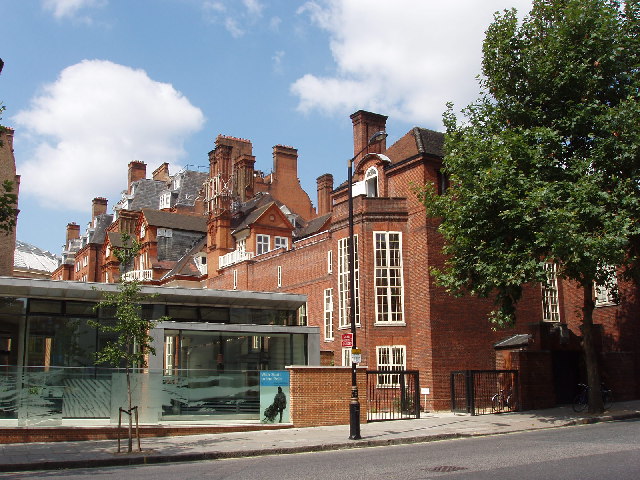
KING'S COLLEGE LONDON: MAUGHAN LIBRARY


King’s College London, is the fourth oldest university in England, has an enrollment of 23,000 students, of which over a third are graduate students. The university comprises many different campuses, most of which are in central London. Internationally recognized faculties of law, nursing and medicine are complemented by strong representation in the humanities and social sciences.

Our initial tour guide for the Maughan Library (Strand Campus) was Sally Brock, who is a librarian. She explained that four smaller libraries had been amalgamated in 2001, when the vacant buildings that had formerly housed the Public Records Office became available. The national Public Records Office is now housed at Kew in Southwest London. The building has Grade II* status, which means that prior approval from English Heritage has to be sought for any changes to be made to the building. The building was originally built in 1851, and load-bearing considerations became a real issue when the conversion to a library was being considered. Plans to create fashionable open space collaborative work areas, foundered on the same rocks.

This is not a public library, although external graduate and undergraduate researchers are encouraged to use the library. The Strand Campus is the home to the humanities faculties, and the Maughan library services the needs of some 11,000 students. However, students in remote campuses have university-wide reading and borrowing access. The library is open seven days per week, with hours ramping up to 24/7 at exam times. The library has subject specialists and is going to the self-service check-out system (RFID) in the fall.

Michael, our second tour guide took over, explaining the cell-like construction of the original building. There were many fire protection features that were considered in the 1851 designs. Rooms were built with fire-proof doors, with exposed timbers being clad in zinc, and then painted to look like wood. A huge water cistern built high in the external bell tower could be called upon by fire-fighters if the need arose. Looking at the beautiful Victorian Gothic exterior, one would never know the cistern was there.


We toured an original 1851 “cell” that has been left with the original fire-proof shelves. They are made from slate, to help with fire retardation, all supported on a steel framework, which carries a mezzanine level. These shelves would mostly have stored rolls of parchment. The rolls would then have been stacked, perhaps five high, which accounted for the small gaps between the shelves.

Having seen the computer labs, we then went into the Central reading room. The beautiful proportions of this elegant top-lit space were copied from the reading room at the British Museum. This reading room contains humanities reference materials and space for approximately 45 readers. An inner-leaf ceiling made from zinc is suspended underneath the roof and painted with to a very pleasing effect.


Hugh Carrol was our guide for the Foyle Special Collections Library. The collection contains about 150,000 items at a conservative estimate. Being quite small, the library has space for 12 readers, who are invigilated by a member of staff when the reader is accessing an item. The collection is maintained to British Standard (BS) 5454, which governs appropriate levels for humidity, temperature, security, etc. Hugh showed us many interesting items demonstrating the strength of materials collected by appropriate teaching departments. The medical and nursing faculties, for example, were represented by several ancient medical texts and an 1859 nursing report drawn up by Florence Nightingale on the post-combat fatality rate of soldiers in the Crimea War.

Care for the Foreign and Commonwealth Historical Archive has recently been inherited by Hugh and his two full-time colleagues. This collection contains a vast amount of early materials relating to the creation of the British Empire. Hugh told us that there is a large amount of material on the slave trade and on the history of emigration to Australia. Cataloging is under way, with a retrospective card catalog being created in tandem with the new computer records. Once completed, this will be a huge boon to researchers working on how “Britain” became “Great Britain”.

This was a most interesting tour, if only from the point of view of early fire retardation techniques. This is a very elegant Victorian building, which has been given a new and appropriate lease of life.


Background information gathered at: http://www.kcl.ac.uk/about/
Library website: http://www.kcl.ac.uk/iss
Check out the 360 degrees web-site at: http://www.kcl.ac.uk/virtualtour/strand-campus.html

Thursday, 29 July 2010

BRITISHNESS (vi): WORDS

THE NIGHT MAIL

It will come as no surprise, as you read further into this blog, to discover that I am fascinated by words. I am equally entranced by the shape of the words on the page, as I am by the sound they make. The words bubble, nemesis or idiosyncratic each have their own form, cadence and character. The English language has a vocabulary that is wider and more varied than any other in the world. We are the proud inheritors of billions upon billions of utterances.

In 1936, the General Post Office (GPO) Film Unit produced a short documentary film entitled Night Mail. The bulk of the narrated voice-over was written in the form of a poem by WH Auden. It tells the simple story of an overnight mail train as it travels from London to Scotland. Heading north, the train speeds up, climbing into the Pennines and beyond and the rhythm of the poem changes. It slows and changes again as the train nears its destination.

This film harks back to an age long gone. But, in my opinion, the words, and the sounds they make are as fresh as the day they were written. Have a look (and listen) and see what you think.
http://www.youtube.com/watch?v=zmciuKsBOi0&feature=related
“This is the Night Mail – WH Auden”

An alternative version of the poem: http://www.youtube.com/watch?v=b8_jmtbvzmY&NR=1

For further background on the film: http://en.wikipedia.org/wiki/Night_Mail

Wednesday, 28 July 2010

THE LONDON LIBRARY


The London Library is a private library, founded by Thomas Carlyle (1795-1881) and a group of like-minded readers. Carlyle and his co-founders believed that one should be able to check out a book and then take it home. The British Museum, as the only public library in London in the mid-19th Century, did not allow customers to take books home. Opened in 1841 the London Library was founded by bibliophiles for bibliophiles. Not surprisingly, the library permitted members generous check out periods and this practice continues to this day. The library is located in St. James's Square, London.


Literature and authors have always been very much front and center in this library. Charles Dickens, George Elliot, Charles Darwin, Ian Forster and Edith Sitwell were all members of this private library. Sir Tom Stoppard, the playwright, is the current president. Former presidents include Alfred Lord Tennyson and Rudyard Kipling. There are currently 7,500 members, with a “churn” rate of approximately 25%. This means that the library has to keep moving forward, having to constantly draw in new members. Membership currently costs £395 per annum, with no joining fee. Members have a constitutional and vocational desire to voice their opinions. This encourages a constant and lively two-way dialog between the 60 full-time staff and the members.

The library has a million volumes, the whole of the collection is shelved on-site, and as a consequence, books are crammed into every nook and cranny. A major refurbishment program is nearing completion, and this has increased shelf-space by 30%. The library has grown organically since its’ 19th Century beginnings. Three structures, the Back Stacks, the St. James’s Building stacks and the Central Stacks are connected; it seems to the novice stranger, in a very haphazard way. Some of the earliest stacks, built in 1898 are “listed” by the British Government, because they are the only surviving library shelving system of their kind still in use in the UK. Each floor literally supports the one above and below, like a giant “erector set”.

These stacks have a charm and majesty all of their own, even down to the Victorian hand-painted wall signs, indicating up or down directions to parts of the collections.

A fourth set of stacks, housing a new art library, built over four floors, is a delightful new addition. Modern steel and wood treatments, combined with illuminated glass walls for the upper mezzanine level, give one the feeling that the books are somehow floating. This is the very best of library design work --the lay-out is highly practical and the effect is visually stunning.


The collection was originally re-cataloged by Charles Hagberg Wright, who was the head librarian from 1893 to 1940 and is heavily weighted towards the humanities. The collection is divided by subjects, and then into floors within the stacks. So for example, the Back stacks contain the following classifications; topography, history, science and miscellaneous and annuals, spread over seven floors. Art is the second biggest stand-alone classification, after literature. The Central stacks classifications are; fiction, philology, anecdotes, biography, philosophy, religion, children’s books and law. Periodicals and a huge newspaper collection, are stored in the basement. There are some odd anomalies within this rather creaky classification system. World War I is referred to as European War I, and, you’ve guessed it, WW2 is referred to as European War II. (No mention of Iwo Jima, the Dardanelles or General Slim, then!).


The catalog is equally creaky. Nearly half of the collection is computerized, and easily searchable in the usual way. The other half of the collection is cataloged in what are called the “Guard Books”. These are printed volumes, classified as if they were a card catalog. Titles are classified as per the broad outlines detailed above. Books are then given a sub-heading within that classification, and then are shelf-marked with the initial of the author’s last name. So, for example, a book by John Wells, on the history of the London Library, is classified under “Bibliography.Libraries”. Having found the bibliography section on floor five of the Central stack, it is a simple matter of following the shelf nearly to the end, where under ‘W’, for Wells, one will find the title. Books do not have labels on their spines, instead customers and staff rely on the shelf-mark system.

On first examination this system seems cumbersome compared with Dewey. However, there are two principal advantages. Firstly, serendipitous browsing “around” a topic is a joy. Secondly, it facilitates the shelving of foreign language editions within the one shelf mark. Therefore, three editions of War and Peace, in English, French and Russian, will be shelved in Fiction, under ‘T’ for Tolstoy. The library has a huge number of titles in over 50 foreign languages, with especially strong representation in the romance languages.


The library has a devoted conservation department, who re-bind 4,500 books every year. We had an excellent tour of the department by Stella Worthington. Many of the volumes in the library are first editions and very rare. The London Library believes that it is not a museum, that books are for using and consequently, 97% of the collection is available for loan. The library has a 4th folio edition of Shakespeare that forms part of the 3% of holdings that are under lock and key. We were also lucky enough to see a 1521 edition of a book of poems that had belonged to Henry VIII.

On average, the London Library adds 8,000 new titles to the collection every year. But it also has a “no weeding” policy. Books are not thrown away, and weeding only ever happens if a title is an exact duplication of a title already owned. The library rarely buys paperbacks. After all, the book may be on the shelf for 200 years, and in this library it will be expected to last. The library also operates an extraordinary postal lending system. If a member lives outside of London, or in Europe (temporarily or permanently),titles are mailed out to the member at no cost. The reader stands the cost of the return postage and has to replace the book if it is lost in transit. The circulation desk think nothing of posting a book that may be a first edition, and 200 years old, to a member who wants to read it!

This is a service-orientated organization. The staff takes great pride in their work, as was evidenced from the excellent tour that Helen O’Neill and Stella Worthington gave us. There is much evidence of on-going development at the London Library. It is a thriving and healthy organization. It is a charming, unique and delightful building. If I lived in London, the ink would already be dry on my application form!

London Library website: http://www.londonlibrary.co.uk/

Tuesday, 27 July 2010

ROYAL GEOGRAPHICAL SOCIETY TOUR

Figure 1

Tour Date: July 27, 2010

We have been very fortunate on this course to have had some very good tour guides, and this tour was no exception. Our guide was Mr. Eugene Rae, who is the librarian for the Royal Geographical Society (RGS). The library is located at the headquarters of the society in South Kensington.

The RGS is a private club and currently has approximately 15,000 members. Recent large injections of money from the National Lottery Fund has enabled the building to be expanded, paid for much-needed work to bring all the disparate collections into one area and also subsidized the transferring of the card catalog on to computer records. The main aims of the RGS are to; communicate and exchange information with other Geographical Societies, build and maintain a collection of maps, books and photos, collect scientific instruments, and lastly, provide a forum for the discussion of Geography in general.

The RGS grew out of a gentleman’s dining club, was founded as the RGS in 1830 and originally had premises in Saville Row (where Gieves and Hawkes are now). The RGS moved to its’ present address in 1912, occupying the house that the Speaker of the House of Commons had vacated. Eugene explained that the original building, built in the 1870’s had been added to in the 1920’s and in 2004. After touring the Ondaatje Theater, which is used for lecture programs, we went into what had been the map room.

Eugene explained that the foundation date was significant in terms of the collections that the RGS developed, for by the time the society began, the only areas of the globe that were significantly unexplored, were central Africa and the two poles. Portraits done in oils of Captain Scott, Dr. David Livingstone and Henry Morton Stanley demonstrated his point. The Society provided funding, logistical support, equipment and advice to countless expeditions. The map cases and tables in this room were used to plan many expeditions. There is a real connection with history here, for Scott, Amundsen and Livingstone had all pored over maps in this room whilst planning their expeditions. Appropriately, the only exception to this 19th and 20th Century grouping was a fine portrait of Captain James Cook. Also displayed in this room were models of Mount Everest and a large Portuguese map drawn in the 1640’s, written in Chinese, that was created in great secrecy for the Chinese Emperor.

Before going into the Great Hall, we stopped to look at various exhibits. Henry Morton Stanley, working on instructions from the editor of the New York Herald, went to Africa to look for Dr. Stanley Livingstone. When they met, he greeted him on the shores of Lake Tanganyika with the famous question “Doctor Livingstone, I presume?” Later in the tour, we saw the two hats the two men were wearing in the famous picture produced later, illustrated below:


Figure 2


Livingstone died in Africa in 1873, and was buried under a tree, his body being interred in Westminster Abbey in 1874. The tree under which he was buried was treated as a temporary head stone. Later, the tree was cut down and the section of the trunk carved with the inscription, was transported to England and it now stands in the RGS building. Illustrated below:

Figure 3

The library reading room of the RGS is in the most recent 2004 addition to the building. The library contains over two million items comprising;

* Over one million maps and charts
* Over 2,000 atlases
* 500,000 pictures, including many rare photographs
* 250,000 books and periodicals.

The RGS employs 40 staff, of which 9 work in the library and archives.

The Society is home to approximately 1,500 artifacts and Eugene gave us a very thorough and detailed review of some fascinating articles from polar and African expeditions. A stove used in the Peary expedition sat alongside fabric sacks used to apportion “sledge rations” of tea and sugar to the ill-fated Scott polar expedition of 1912. Shackleton’s balaclava-style snow hood, signed by him, is in a remarkably good state of preservation. The Livingsone theme continued, with his signature on his 1857 application to join the Society, signed by all the committee. A simple and elegant picture of the Victoria Falls, drawn by Livingstone is the first picture ever done (by a European) of that cataract.


Figure 4
For me, the most chilling item we saw was the climbing boot of George Mallory. Mallory and Andrew Irvine died whilst trying to climb Mount Everest in June 1924. They were last seen “going for the top” by fellow expedition members, when they disappeared behind clouds. I went to school with James Irvine who was the nephew of Andrew Irvine. James told me that some members of the Irvine family believed that the two climbers went “over the top” of Everest, and carried on to Shangri-La beyond.

Part of that myth was brutally destroyed when in 1999, a TV crew discovered the part-decomposed body of George Mallory on the lower slopes of Everest. Eugene showed us one of Mallory’s boots that was returned from the mountain, and is now being looked after by the RGS. An examination of Mallory’s clothing showed him to have been wearing not much more than a suit jacket and trousers. Andrew Irvine’s body has never been found. I wonder if his descendants are still living in Shangri-La?

For me, this tour has brought to life some fascinating aspects of British polar and African exploration. Our guide, Mr. Eugene Rae, was most kind and generous with the time he gave us, explaining in a very knowledgeable way this most fascinating area of British history.

Royal Geographical Society: www.rgs.org
Royal Geographical Society Library: http://catalogue.rgs.org/uhtbin/webcat
Picture Sources:
Figure 4: George Mallory's boot on Mount Everest

Monday, 26 July 2010

BRITISHNESS (v): "FOUR CANDLES"

Words have the power to do many things, including being able to confuse and amuse.

The Two Ronnies was a highly popular BBC TV comedy that aired in the UK in the 1970’s and 80’s. The title was taken from the first names of the two stars, Ronnie Corbett and Ronnie Barker. During the 1970s and 1980s they produced a series of classic TV comedy programs that consistently topped the ratings.

Often involving visual gags, their real comic power came from well-crafted scripts that revolved around word play, parody and mild sexual innuendo. The English language has a vast range of paired words that sound the same as their partner. The success of the "Four Candles" sketch revolves around the miss-understanding that results from miss-hearing what the customer wants.

http://www.youtube.com/watch?v=OCbvCRkl_4U “Two Ronnies – Four Candles”

Sunday, 25 July 2010

DUNFERMLINE CARNEGIE LIBRARY


The Dunfermline Carnegie library was the first Carnegie library to be built, and was opened by Carnegie’s mother in 1883. It is a solid building, built on a corner plot in the town Carnegie was born in. Located in the county of Fife, it is the busiest library in the county.
Stephanie Anderson gave us a very complete tour of the local research resources that the library offers. They hold parish registers from 1841 onwards, census records, valuation rolls (domestic and commercial) as well as an extensive local photo archive. We saw the Special Collections area, and we were given a very comprehensive tour of the Murison-Burns collection. This is a large collection of materials on the Scottish poet, Robert Burns. Our tour then continued into the Children’s library – a bright and airy room, which has additional titles for children written in Urdu, Chinese and Polish. The music library closed some time ago.


After we had coffee and cookies, I spoke at length to Stephanie Anderson about a scheme that she mentioned in passing during the tour. In 2006, a nationwide pilot scheme was started in Fife as a partnership between the NHS Fife Clinical Psychology Department and the Dunfermline Carnegie library. Called the “Book Prescription Scheme”, the idea is that a local doctor can give a prescription for a book to a patient when they are in the surgery. The patient then takes the prescription to the library, and the title is handed over with minimal fuss for the customer. The scheme is aimed at patients who have mild to moderate psychological issues. Titles can be checked out for six weeks, and the scheme is confidential.

I asked Stephanie what the immediate benefits for the customer were in accessing library materials this way. She said that there were three main advantages. Firstly, patients for whom English is not their first language can take a book home on a health matter, and read/translate the book in the privacy of their own home and at their own pace. Secondly, for customers who have poor reading/writing skills, it is attractive to be able to go into the library and hand over a book request that is already completed for them. Thirdly, customers can come into the library and not have to research the topic themselves, thus avoiding embarrassment at the interview stage with library staff. Stephanie said that for many of the users of this scheme, this book prescription visit was the first time they had visited a library.

I am indebted to Stephanie, who gave me a lot of materials on this project, including an NHS booklet that describes how the scheme runs. When prescribing a book for a patient, the doctor has a list of 39 titles covering 15 key areas. “These include depression, eating disorders, obsessional-compulsive problems, social phobia, panic, anger, low self-esteem, relationships/psychosexual and the aftermath of sexual abuse. Many of the books have been written by leading practitioners (mostly clinical psychologists) in the mental health field and many are in fact self-help adaptations of well-established clinical treatments of proven effectiveness”. 1

A random selection of titles will give you an idea of the types of books that are being provided: Overcoming Anger and Irritability, Helping Children Cope with Grief, Climbing Out of Depression, Bulimia Nervosa and Binge Eating, Overcoming Low Self-Esteem and How to Stop Worrying.

The booklet names this process as “bibliotherapy”, and makes a good case for self-help books being efficacious for many patients. It does stress that not all patients benefit from bibliotherapy help. This was a most informative discussion and has given me a great deal to think about.


The website for the library is: www.fifedirect.org.uk/libraries

E-mail for Stephanie: stephanie.anderson@fife.gov.uk

1 Dunfermline and West Fife Mental Health Primary Care Book Prescription Scheme. Booklet published by NHS Fife and Fife Council Community Libraries. No publication date. Page 5


Dunfermline Abbey

Saturday, 24 July 2010

ENGLISHNESS (iv): ROOKS


The Rook (Corvus frugilegus) is a type of bird. The adult is black/purple in color and they build their nests in tree-tops, which are called rookeries. They feed on worms, insects and grain. They are said to be a highly intelligent bird, and they are very sociable, joining together to make large colonies. They have a very unusual call, which is a “kaah” noise. The sound rooks make, I think it is particularly English.

Have a look at: http://www.youtube.com/watch?v=ehojFux0bNc&feature=related
“Rooks going to Roost”. Accessed 7/24/10

Consulted to write this blog: Holden, Peter. The RSPB Guide to British Birds. Pan Macmillan Ltd., London, 2002. Page 164.
PS The collective noun for a group of rooks is a 'parliament'. Make of that what you will.

THE JOHN JOHNSON COLLECTION

AN ARCHIVE OF PRINTED EPHEMERA,
BODLEIAN LIBRARY, OXFORD

Dara, Gillian, Traci and I were very lucky to have a thorough and detailed tour of the John Johnson Archive of printed ephemera, which is housed at the Bodleian Library in Oxford. Our guide was Amanda Flynn, who is an archivist at the Bodleian. The collection is housed in the new Bodleian Library, with workshops being on the ground floor, and materials being stored mostly in the stacks.


John de Monins Johnson (1882-1956) worked for the Oxford University Press (OUP), and the collection is named after him. Amanda explained that Johnson was a papyrologist, and his studies of fragile ancient Egyptian texts, lead him to realize that printed materials from his own era were just as fragile, and just as likely to be thrown in the trash. So he started a collection of printed ephemera, now containing approximately 1.5 million items, dating mostly from the 18th ,19th and 20th Centuries, with the cut-off date being WW2. Initially housed at the OUP offices, the collection was gifted to the university in 1968.

The collection includes a vast range of printed items. Playbills, programs, prints, newspapers, handbills and pamphlets sit alongside advertizing materials of all types. This collection is an invaluable resource for many different kinds of researchers, from those looking to see what an Edwardian theatre playbill looked like, to a hastily published newspaper, giving an account of a public hanging in the Victorian era. Because of the huge quantity of material, cataloging is critical for efficient access. Johnson himself cataloged his collection. Amanda conceded that the 700 subject headings that he created for his materials were so good that it is the one that is still broadly used today.

In 2006, a large scale joint-venture digitizing program was established between ProQuest and the Bodleian, under the auspices of the Joint Information Systems Committee (JISC). JISC put up the funding with the aim of preserving and protecting fragile collections such as this one. ProQuest put up half of the £2m budget and JISC the other half. The agreement was that UK- based libraries and schools would have free access to the digitized collection, and those outside the UK would have to enter into a contract with ProQuest to be able to access the images.

It was seen as being unrealistic that the whole of the collection could be digitized, so the £2 m was spent scanning 62,421 items (167,356 images) and creating 60,300 new catalog entries. Amanda showed us multiple examples of the five categories of materials that were nominated for early inclusion;

* 19th Century Entertainment, including theater material and non-theatrical materials, such as circuses.
* Popular Prints. This category provides researchers with a huge range of visual information of both social and historical significance.
* Crime, Murders and Executions. Broadsides and pamphlets from court cases, and more lurid publications of grisly crimes are a treasure trove for researchers.
* The Book Trade. Examples of book publishing ephemera, including prospectuses and bookplates.
* Advertizing. This is popular culture in the raw, and is a rich vein for students of fashion, industrial processes, social/historical trends and habits, etc.

The workroom in the New Bodleian Library: A small selection of the collection.

The work commenced in 2007, took two years and involved 10 staff from the Bodleian. The academic input was provided by Bodleian staff and the digitization process was broken down into four discreet processes;

1. Sorting. The items were put into categories and given shelf marks.

2. Cataloging. New records were created, using the Allegro Bibliographic format. The catalog entries thus created are very complex, allowing multiple entry points for searching. Researchers may be researching theater history, or the history of an actor, or the typography used in early Victorian playbills. Amanda explained that a playbill might have included references to the theater, the name of the play, the theater manager, the players, a description of items contained in pictures included in the playbill and so on. Additional information would be included on dimensions, coloring, printing and paper processes used, etc. (i.e. copper engraving, wood block, Baxter-print etc). Only by including multiple search terms in the catalog entry, would this resource be of any future use to researchers. At this stage the paper conservation department did any necessary work needed to repair or conserve the item.

3. Tracking. Each item was assigned a barcode tracking number, allowing all the different departments to locate precisely where an item was at any given time.

4. Digitizing. The bulk of this work was done by an outside contractor, Capita, who are based in the nearby town of Bicester. Some of the more delicate time-consuming items were digitized in-house at the Bodleian.

Amanda then went on to show us how efficacious the search processes are. The work put into cataloging the collection, started by John Johnson, has paid off handsomely, because a part of this unique resource is now searchable and accessible in many different ways. For the first time, Johnson’s collection will open up its secrets in interesting and diverse ways to researchers working in many different fields.

I have used all of the web-sites listed below in researching this blog.

This web-site gives a brief history of the collection within the Bodleian: http://www.bodley.ox.ac.uk/johnson/johnson.htm

This site provides a lot of additional information:
http://johnjohnson.chadwyck.co.uk/marketing/about.jsp

More detail on the digitizing process can be found at:

EDINBURGH CENTRAL LIBRARY


Visit Date: July 17, 2010

The Edinburgh Public Library was endowed with monies from the Carnegie Trust and was opened in 1890. The Carnegie inscription over the door reads “Let there be Light”. The Central library has 40 staff, and is the coordinating hub for 14 branch libraries in Edinburgh. The Central Library is literally and figuratively at the heart of access to learning in the city. We were shown some new and imaginative ways in which the staff is re-energizing the relationship between reader and library.

Our tour started with three lectures on different aspects of the running the library. After some introductory remarks, Alison Stoddart started by telling us how the library is working with web 2.0 to “reach” into the community in new ways. The main thrust is to renew (and in some cases build from scratch) connections with the community. “Your Edinburgh” is a web based initiative designed to link community and individuals together, giving “ownership” of events and handing projects back to communities. This web-site is designed to be a multi-layered bulletin board for the city, providing timely and accurate information, focusing particularly on health advice, learning, history, etc. It will be coordinated from the library.

Alison also discussed how the library is involved in a project called “Capital Collections”. This initiative will continue to digitize and make available many of the large number of antique photographs that the library has. This way, the portfolios of Victorian photographers such as Hill and Adamson, will be available to a wider audience. Web 2.0 is being used to reach further than existing schemes currently permit. For example, the “Word Up” scheme is a digital newsletter for library customers, currently reaching 2,000 subscribers. The library blog, “Tales of One City” informs of timely events, such as golf tournaments or the Edinburgh festival. The blog currently has 5,500 visits per month. Twitter is used as a good conduit for praise/criticism, and is seen by Alison as being vital in heading off crises before they happen.

Annie Bell and Colm Linnane headed up the next session, and they took us through the ways in which the library is working with special interest groups of library users, trying to improve library take-up and functionality. The library is placing reading at the heart of its outreach work. Events where fans can meet and interact with authors are good for both “sides”. In small groups, the library encourages “emerging” writers, in an attempt to encourage and enthuse. “Crime in the City” is a project to encourage and stimulate readers and writers of crime fiction to interact. The impressive range of “book group” activities includes;

* “Take a Break with a Scottish Book”; a project to stimulate summer reading
* Hearing and sight impaired book clubs
* Book clubs for soldiers’ barracks
* Book group books. The library offers packs of books of the same title for book club users to have the experience of all reading the same edition.
* Private book clubs. When asked to, the library liaises with private book clubs, providing help and support.
* Themed book clubs; for example clubs will read the winning titles of the Booker or Orange Book prizes.

The library is involved with a three year training program called “Front Line” (http://www.openingthebook.com/) which is taught on-line in seven modules. The impressive list of out-reach links also includes;

* Reading in care homes. Experience has shown that showing photos, accompanied by specific readings can help re-create and re-focus memories for Alzheimer’s patients.
* Oral story telling is a very useful tool in trying to get troubled teenagers in residential care involved in story-craft, without confronting the issue of illiteracy and the accompanying feelings of inadequacy. Many of these sessions involve a “meet the author” session.
* The Scottish Book Trust is a publishers group that is interested in promoting small publishers. Quarterly meetings actively encourage these businesses on a partnership basis.

Karen O’Brien then led us through the conservation issues and problems associated with a large metropolitan library. The library has many rare and unusual items in the collection and the boundary between preservation requirements and access often becomes unclear. By showing lots of different examples, Karen covered very effectively, the problems associated with acid-rich paper, binding and preservation issues.

We then went on a tour of the various areas of the library, starting with the local history section. The library has a unique and diverse collection of materials on Edinburgh, including extensive genealogical resources. We dodged the rain to go into a separate building which contained the children’s and music libraries. Back in the main building, the general lending library is very well used and is the busiest in Edinburgh. The fittings are the original Carnegie ones, with the exception of the central enquiry desk. Upstairs is an impressive art library. A large number of art and design colleges in the city, and surrounding hinterland, make good use of this collection. Downstairs is the original Carnegie reference library, no longer divided into men’s and ladies’ sections, but now providing reading desks for 150 readers. There is a very good selection of daily newspapers and periodicals in this department.

Although built over a hundred years ago, the staff in this library is involved in a lively and bold debate with their customers. They are taking the book to their constituents, and also informing the city, by proactively using many of the tools that web 2.0 provides. I applaud them for their initiative and fortitude. I wish them luck in the straightened times in which we live.

ENGLISHNESS (iii): BELL RINGING

For me the sound of bells being rung from an English country bell tower is the essence of Englishness. Have a listen to the bells of Prestbury Church, Cheshire, being rung (“Prestbury – St.Peter’s Church 5”) http://www.youtube.com/watch?v=kTudBZfGs_Y

The poet Sir John Betjaman was fascinated by church bells. Verse three from his poem Church of England Thoughts Occasioned by Hearing the Bells of Magdalen Tower from the Botanic Garden, Oxford on St. Margaret’s Day:

“A Multiplicity of bells
A Changing cadence, rich and deep
Swung from these pinnacles on high
To fill the trees and flood the sky
And rock the sailing clouds to sleep”. 1

Tuned bells, hung in a bell tower ("pinnacles on high") are rung in a pattern called a “change”, by pulling on ropes from a platform built below the bells. Large groups of bells hung in a tower, are called “rings of bells”. The bells swing freely to a determined pattern that does not produce a melody in a formal sense. Have a look at: http://en.wikipedia.org/wiki/Bell_ringing. This Wikipedia article explains the intricacies of bell ringing, and you will see from the article, which is entitled “Campanology”, just how involved the vocabulary is for this subject.

1 Betjaman, Sir John. The Collected Poems. Book Club Associates, London, 1975. Page 193.

Friday, 23 July 2010

ENGLISHNESS (ii): LITTER


In my search for things quintessentially English, I am writing about an unfortunate English problem. Litter. Boris Johnson is the Mayor of London. He frequently writes a column for The Daily Telegraph newspaper. In a recent article, he wrote of how unsightly discarded chewing gum despoils the sidewalks of London. “It is like a plague. It is a monstrous acne of sticky grey blotches. It is an awful self-inflicted impetigo on the face of modern London…”1 Johnson goes on to say that an on-the-spot fine of £80 should be levied on those dropping gum on the sidewalk.


I would take issue with Mr. Johnson. Instead of fines, London needs more public trash cans. Litter and discarded chewing gum rule in a land of no trash cans. All around the country, trash cans were removed after the IRA started putting bombs in them in the 1970’s. Trash cans made a return in the late 1990’s, only to be removed after the London 7/7 bombings of 2005. The result is that we now have litter everywhere, including the ubiquitous “acne” chewing gum blotches. I wish it were not so.


1 The Daily Telegraph. “Our Streets are Suffering From a Monstrous Plague of Blotches”. July 12, 2010. Page 16.

THE BODLEIAN LIBRARY


Oxford University claims the honor of being the oldest university in the English speaking world. The Bodleian Library is the library of Oxford University. We were most fortunate to have an excellent tour of the library from Mr. Ian Mitchell, who is a most knowledgeable (and lively) tour guide.

He started by giving us a historical overview of the history of the university, whilst sitting in the room that was formerly the Divinity School. The building was built in the beautiful late gothic English perpendicular style. Ian explained that the Divinity School acted as a school room and also as a venue for “examination by oral disputation”, which was the verbal examination system used to award degrees at Oxford. We then moved to the Convocation House, where King Charles I held three parliaments when his court was in exile during the English civil war.

The Divinity School

Adjacent to the Convocation House is the Consistory Court established in 1214 and is where university staff and students were tried by the university authorities. Through the windows one can see the Sheldonian Theater, the first commission for the architect, Sir Christopher Wren. The Sheldonian is the main ceremonial hall for the university.

The first library in Oxford dates from the 14th Century. Humphrey, Duke of Gloucester (brother to King Henry V), donated a large collection of manuscripts to the university (1435-37) and constructed a library, built above the Divinity School. Completed in 1488, it is known as Duke Humphrey’s library. Thomas Bodley (1545-1613), an Oxford alumnus, later re-fitted the library and donated many of his own books. It was re-opened in 1602, now bearing the name of its’ latest benefactor. What is presently called Duke Humphrey’s library is largely the work of Bodley, including many of his 17th Century innovations. He built bookcases, in the form we know now, and until the 1780’s the books were chained. He also added galleries with access via stairs, the entrance and egress from which could be scrutinized by staff.

Humphrey’s library has a beautiful hammer beam roof, decorated in an elaborate arabesque style. The portraits of 34 heads of colleges look down from the walls. Below are cubicles with benches and chairs where “readers” sit and work. The Bodleian is a reference library and books are delivered to the readers in the reading room of their choice, by staff from closed stacks. There are some 55,000 registered readers, with 25,000 of those being university related.

The new Bodleian Library was built in 1933. Designed by Sir George Gilbert Scott, with generous gifts from the Rockefeller Foundation, it has 11 storeys of stacks, eight above ground and three below. We toured the tunnels that connect the libraries below ground and saw the book conveyor system and pneumatic tubes that were formerly used to deliver the book request slips. Currently, book retrieval times can be up to three hours. The basement stacks had a variety of functions in WW2; bomb shelter, repository for other libraries’ holdings (including many from the Royal Collections), depository for the seeds collection from Kew Gardens and the WW2 Red Cross records.


The New Bodleian Library

Exiting the basement levels, Ian took us back to the main entrance and showed us the exteriors of the libraries we just toured, including the Schools Quadrangle. Doors off this quad lead to separate faculties for the teaching of logic, astronomy, morals, law, medicine, etc. He pointed out the tower and the five styles of classical columns built in pairs flanking the gate; Tuscan, Doric, Ionic, Corinthian and Composite.

As with the British Library, the Bodleian does not use Dewey numbers, but rather arranges books by size to save space. The library has many items of huge antiquity, including an Egyptian papyrus marriage contract from 567BC. The library holds collections in many languages, having for example, the second largest collection in the world of Hebrew texts.

Some 5,500 new books are added per week to the collections and therefore the new library, built in 1933 is full. A new off-site facility in nearby Swindon is starting to house the overflow. The library will shortly undergo a re-fit costing £98 million to upgrade the library. This tour was most interesting, and Ian a most fascinating guide.

Greek inscription written over the door to the Divinity School

THE NATIONAL LIBRARY OF SCOTLAND


Opened in 1689, The National Library of Scotland started life as the Advocate’s Library, a private library. The library was granted the right to claim a copy of every book published in Great Britain under the 1710 Copyright Act. Under this new entitlement, the collection grew rapidly and the whole was donated to the nation when it was formed into the National Library of Scotland (NLS) in 1925.

After delays occasioned by WW2, the building the NLS presently occupies was opened in 1956, after generous bequests from Sir Alexander Grant of Forres. The building ranges over 15 floors, and because of the ever-expanding collection, has subsequently required two additional further buildings to be built. The Legal Deposit Libraries Act of 2003 means that the library now has the additional right to collect digitally published work, including e-journals and websites.

As you enter the museum, there is an exhibition display. A header above one of the exhibits states; “Today the National Library of Scotland is the home of our nation’s collected knowledge and history, and occupies a central place in Scottish cultural life”. It goes on to list that the library is home to 14 million books and manuscripts, 2 million maps and atlases, 300,000 musical scores, 32,000 films and videos (The Scottish Screen Archive), 25,000 newspaper issues and 7,500 sound recordings. Six thousand new items are added per week to the collection.

The exhibition starts with a display of Timothy Pont’s maps of Scotland. His remarkable maps of the 14th and 15th Centuries are some of the earliest maps drawn of Scotland. They show churches, towns, castles and topographical features. This small “taster” of what is in the NLS is far too small. Unfortunately, the rest of the exhibit is poor, and does not reflect adequately the treasures that the NLS holds. A rather trite golf exhibition neither informs nor educates. The third section of the exhibition is supposed to be an introduction to the John Murray Archive. This display is so sketchy and poor that I had to go to the bookshop to find a book in order to find out what this section of the exhibit was all about!

The John Murray Archive (JMA) was donated to the museum in 2006, and contains a vast collection of materials from the London publishing house that was founded in 1768 by John Murray. Born in Edinburgh, Murray was to found a publishing dynasty, with a further three generations succeeding in the business after him. The JMA, covering holdings dating from 1768 to 1920, covers a veritable “who’s who” of British publishing. A publishing list to die for included Jane Austen, Lord Byron, Charles Darwin, Humphrey Davy and Benjamin Disraeli, to name but a few. The archive offers us a peek into the partnership between publisher and author. The collection is full of nuggets such as a letter from Byron worrying that one of his books may be too small to sell. Letters from Jane Austen complain that the printer is too slow. Copies of the correspondence between Charles Darwin and his critics fill many boxes.

The Murray family was a publishing dynasty which lasted for four generations. But the archive also contains other papers, for example from the London publisher Smith, Elder and Co., who were the publishers for Sir Arthur Conan Doyle, Mrs. Gaskell and the Brontë sisters. During the Victorian era, the Murray catalog also included works from many scientific disciplines, including geology, astronomy, botany and chemistry. The most famous scientific text published, though, has to be Charles Darwin’s Origin of Species. John Murray II and III expanded the catalog to include exploration and travel, subjects that were very popular with the Victorians. This period saw the publication of the works of Sir Walter Scott, a publishing phenomenon that made the house a huge amount of money.

I am indebted to the book entitled Ideas that Shaped the World; An Introduction to the John Murray Archive. Editor, David McClay. NLS Publications, 2007. A good museum should challenge, guide, entertain and above all, inform. Sadly, this museum does none of these things. Floreat libra!

THE NATIONAL ART LIBRARY


THE NATIONAL ART LIBRARY


VICTORIAN & ALBERT MUSEUM
LONDON


The Victoria and Albert Museum (V&A) was founded in 1852, and it is the principal museum for decorative arts and design in the UK. With exhibits from all over the world, holdings include the finest examples of metalwork, painting, sculpture, drawings, print making, photography, ceramics, glassware and textiles. The exhibits cover 5,000 years of the history of the decorative arts, up to the present day, with all the major types of decorative and artistic endeavor represented. The National Art Library first opened in 1857, and is housed within the V&A museum in South Kensington. It is a repository for reference materials of all kinds, covering the whole range of materials covered in the museum.

We started the tour in the reading rooms. Floor to ceiling elegant glass-fronted mahogany cases contain mostly reference works in this section of the library. Our guide went through a number of statistics with us at this juncture. The library has 30 staff and has a purchasing budget of £100,000 per year, half of which goes on periodicals. There is no weeding, books are stored by size and are retrieved by staff from closed stacks. A paper ordering system, aims for a request to delivery time taking between 20 and 40 minutes.

The customer is expected to search the catalog by themselves, only to find that works listed in the catalog are frequently not written in English. The catalog sometimes reveals this, and sometimes not. The library has a large collection of art exhibition and sales catalogs from the major auction houses such as Christie’s, Bonham’s and Sotheby’s. These catalogs are a prime historical reference source for tastes, trends and patterns within the major art markets. They are also a very good source of material for information on artists for whom references are not available elsewhere.

We had a number of tour guides, and the constant theme running through the tour was that the library has to “make do and mend”. This was evident in the first closed stacks area we visited. Our guide admitted that the large fans running throughout his area were not exactly helping with climate control, and that the high ceilinged room was either too hot or too cold. Perhaps the most depressing space visited was the West Room.


The whole of this area used to be part of the library. A book lined high-level gallery looked down on to a 20th Century exhibition of furniture and design. The cases along the lower walls were screwed shut to prevent theft by those visiting the gallery space. I asked our guide about the conflict between the ever-increasing need for library shelves and that of exhibition space. She resignedly waved her hand to indicate the shared space in the West Room, and acknowledged that the exhibition side of the museum always won in the fight for space. We toured the office and workroom spaces, and saw the huge quantity of books that are waiting to be cataloged.

Our final guide, Frances Waddle, is the special collections librarian. She had prepared a huge number of varied materials to show us. She showed us a range of materials that demonstrated the development of printing techniques, ranging from an Art and Aesthetics treatise from 1499 to a first folio edition of Shakespeare, to a fine example of the Arts and Crafts movement, being an 1896 edition of a William Morris imprint of The Well at World’s End. A variety of exhibits demonstrated the depth and width of the collection, including letters written by the artist John Everett Millais, to trade literature showing women’s fashions in 1911, to a 1974 book by Edward Roth, having pages with holes in them.

Proofs for Bleak House


Apart from being able to handle a first folio edition of Shakespeare, my favorite exhibit was Charles Dickens’ corrected proofs for Bleak House, annotated in two colors in his own hand. Alongside were the printed serialized editions of the finished work, including charming contemporary 1853 advertisements for top hats and hair oil.

This was the high point for a museum visit that was sobering and rather depressing. The collection seemed to be in danger of overwhelming the staff and the management of the museum seemed to be taking space away from the library at every opportunity.

A rather dull and text-rich website covers the history of the museum; http://www.vam.ac.uk/vastatic/microsites/1159_grand_design/essay-the-idealist-enterprise_new.html

A rather better set of links cover the museum, including details about the catalog, etc.

http://www.vam.ac.uk/nal/about/index.html

Thursday, 15 July 2010

THE INSTITUTION OF MECHANICAL ENGINEERS LIBRARY

Library Visit: July 14, 2010

I have to confess a secret. I knew that I wanted to visit the Institution of Mechanical Engineers (IMechE) Library before coming to London. For, I have an unfashionable hobby. I am fascinated by the work of British mechanical engineers of the mid-19th Century; men such as Henry Maudslay, James Nasmyth and I.K. Brunel. But the giant among giants in the history of British engineering was Sir Joseph Whitworth (1803-1887).


Sir Joseph Whitworth: Google Images: heritage.imeche.org/.../JosephWhitworth.htm

He took world engineering to new places as far as machine tolerances and manufacturing practices were concerned. The Joseph Whitworth Company built the machine tools that other manufacturers used to build the British Empire. He is one of the unsung heroes of the “Age of Empire”. He was the fourth president of the IMechE.


The headquarters of the IMechE is at 1 Birdcage Walk, Westminster. The site was picked to be an imposing location for a society that was founded in 1847. It remains so to this day. Opened in 1899, the building is a bold and blousy, built at a time of great confidence. A mixture of architectural styles is immediately visible when you walk into the imposing foyer. The library was purpose-built and the oak furniture and fittings sit solidly under a Jacobean-style pargetted plaster ceiling. A series of rooms are inter-connected around a central work space. Storage in two basement rooms, combined with two archive rooms, means that all the libraries’ holdings are on site.

One of the main functions of the IMechE is to provide certification and testing for mechanical engineers. Therefore the library has holdings, both ancient and modern, for all the branches of mechanical engineering. The main subject areas for collection are; transport, energy, thermodynamics, fluid mechanics, manufacturing and tribology (the mechanics and science of friction, wear and lubrication). A new category of Biomedical Engineering was added recently to keep up with changing aspects of the IMechE remit.

The building, including the library, is full of beautiful scale models of all kinds. Models of factories, steam engines and trains abound. The library has an extensive array of current national and international periodicals in all the branches of MechE, for members to consult in comfortable leather reading chairs.


The library provides a postal loan service for members living or working in EEC countries. Enquiries from members form a large part of the work of the three library staff (with one archivist). Help is provided with the ever-changing requirements for engineering standards, law and applications. Technical data requests, engineering literature reviews and market research are all part of the work-load.

The first president of the IMechE (1847-8) was George Stephenson and the library has extensive archival information on him and every president. With presidents only serving for one year, there is a great deal of material here for anyone researching the history of the engineers who put the ‘Great’ in Great Britain. I was very lucky to have been helped throughout my visit by Laura Lipner and Laura Gardner. Laura Gardner very kindly took me to see the exhibits in the Sir Joseph Whitworth room, which is used for conferences and meetings.


Google Images: Joseph Whitworth and Company: 1840 Measuring Machine
heritage.imeche.org/.../Whitworth+1840.htm


In two glass cases, they have fine examples of machines that are literally priceless because of their rarity. Built by Joseph Whitworth and Company in 1840, one was capable to measuring engineering components to an accuracy of 1/40,000 inch. The improved second machine, built in 1876, was capable of measuring the same to an accuracy of 1/1,000,000 inch. The 1876 iteration was not improved on for accuracy in measurement until the invention of the laser. I am indebted to Laura Gardner for taking so much time and trouble in helping me with my research.


General library information can be found at: http://www.imeche.org/library/ Links from here take you to the catalog, archive holdings, etc.

Tuesday, 13 July 2010

THE WALLACE COLLECTION


Museum Visited: July 11, 2010

Closest Tube: Bond Street, Jubilee Line (West) 3 stops from Waterloo.

The headline strap on the web-site claims that the Wallace Collection is “A Family Collection. A National Museum. An International Treasure House”. Hyperbole? No! If anything it is probably understating the case. The Wallace Collection is a small, but perfectly formed museum, located in Hertford House, Manchester Square, London. It has some world class exhibits that are well worth going to see. The whole is contained in a fine example of a 19th Century London town house that has been virtually untouched since being built as a family house (with art galleries attached).

The house and the entire collection was built up by the Wallace family (Marquesses of Hertford) and donated to the nation intact by the widow of Sir Richard Wallace in 1897. Unusually, the house was built to house works of art. Each of the succeeding four Marquesses had exquisite taste, and bought only the finest pieces with the correct provenance. The Fourth Marquess, for example, collected Old Masters and Oriental armor. Sir Richard Wallace (1818-90), his illegitimate son, bought European armor. He also purchased many of the fine miniatures and gold boxes that are on display. Not surprisingly, the tastes of each differed and this is what makes this collection so unique and worthy of a visit. Each man brought his own tastes and preferences to bear in their collecting. This breathes freshness and variety into the collection.

There is a strong and long-standing family connection with France. The family had extensive property holdings in Paris and other European locations and the French influence is seen in many of the items in the collection. On the way in to the house, on the right hand side, is a green cast-iron French water fountain. Sir Richard Wallace donated hundreds of these water fountains to the citizens of France, and they can still be seen in Paris, Bordeaux and Lyon. In Paris, to this day, these stylish items of street furniture are still known as ‘Wallaces’ (Figure 2).

Figure 2:
The collection was started circa 1760 and includes many fine Old Masters, with works by Rembrandt, Titian and Velázquez to name but three. Some of the finest European china is on display, including examples of Sèvres, Limoges and Maiolica ware. There is an internationally renowned collection of arms and armor, specializing in 15th Century equestrian armor. Antique brass and bronze collections date from ancient Greece and Rome. But my interest was drawn particularly to the furniture.

The Wallace family collected some of the finest examples of inlaid marquetry furniture. Marquetry is the art of applying a decorative veneer (usually about one sixteenth of an inch thick) to solid wood furniture. Veneers are typically made from wood, horn, turtleshell, ivory, metal and mother-of-pearl. (Parquetry is the art of working in wood). The Wallaces collected the outputs of mainly French factories, who were working in the late 18th Century for the court of King Louis IV of France. There are also many fine examples of the work of the master, André-Charles Boulle (1642-1732) in Hertford House. Boulle is so famous as a marqueteur that his name is applied generically to this style of furniture decoration.

As you start to tour the house, you enter the Front State Room on the right hand side. Two exquisite matching cabinets, to left and right of the archway, are probably by Etienne Levasseur (1721-1798) who was a contemporary of Boulle. They are constructed in pinewood, and over-laid with ebony and in-laid with Boulle marquetry of brass, turtleshell, oak and pear wood. Above the left cabinet is a rare portrait of Princess Victoria before her coronation, with her wearing a tiara. You can see her crown on a table to her right. (Figure 3).

Figure 3:
From the Front State Room you enter the 16th Century Gallery. This room gives you the first taste of what treats lie ahead. Old Masters, superb bronzes, small statuary and Venetian glass bewitch and delight. My favorites are the Limoges painted enamels which repay time spent admiring the craftsmanship that went into their creation.

Color is one of the many things that assail you in this house. A beautiful baby-blue wallpaper in the Dining Room is contrasted with a yellow embossed paper in the Billiard Room. The original Victorian paper was re-created to the same pattern as the original by a French manufacturer in Lyon, called Prelle. This Prelle paper was specifically chosen to accentuate the Boulle furniture and make it stand out from the wall. Two fine examples of André-Charles Boulle’s work adorn this room. The first, on the left, is a set of drawers on a pediment base, circa 1665-70, turtleshell inlaid into ebony (Figure 4).
Figure 4:
The second piece, is a wardrobe with a clock built into the center, built in 1715. It is well worth asking if you can borrow a magnifying glass from the front desk. Only with additional magnification can you start to really appreciate the work that went into this item.

There are many delights to captivate you before you get to the Large Drawing Room. The Londonderry bookcase, as it is known, is the work of E. Levasseur (1721-98) and is 20’ long and over 6’ tall. (Figure 5) Six glass doors, in three sections, are built on an oak frame with an ebony veneer. Be sure to go through the Study, and look at the enameled boxes and miniatures. The craftsmanship is superb.

Figure 5:
The teal-blue wallpaper in the Oval Dining Room and the stripped parquet floors show off to perfection a roll-top desk by a French furniture maker, J.H. Riesener (1734-1806). Built in 1769 on an oak base, this desk is a beautiful example of inlaid marquetry. (Figure 6). Veneers of sycamore, purpleheart, holly, walnut and ebony create patterns that delight the eye.
Figure 6:
The Upper Hall at the top of the stairs has two fine bookcases (c.1770) by Jean-Louis Faizelot-Delorme. They are quite small, but again, the oak, ebony, brass and turtleshell in the hands of this master marqueteur captivate and entrance.

The collection of bronzes in the basement is worth a good look. This level also contains the armor galleries which are well worth going through. All types of antique weapons are on display, including crossbows, swords, muskets, daggers, etc. The suits of armor and the equestrian armor are especially well displayed. What was originally an outside courtyard is now a glass-roofed restaurant. Their English tea is very good – if expensive! This level has two other attractions which might be of interest. The Riblat Conservation Gallery has displays on “how to” conserve various materials, including, yes you have guessed it, marquetry! The museum also has a small, but well resourced library of the decorative arts. The staff on all the floors is very helpful and very well informed, including the librarians.

Having been revived by a cup of tea, you are now ready for the Great Gallery on the first floor. It was added on to the house as an art gallery, and measures 48 yards by 15 yards. It is a perfect environment to view the great collection of Old Master paintings that are on display. Two portraits by Anthony Van Dyck, hang on the same wall as a Rubens pastoral scene entitled The Rainbow Landscape. Opposite is the star painting, The Laughing Cavalier by Frans Hals (1584-1666). The sitter has a very enigmatic expression on his face. What was he thinking about? But for me, the two most precious paintings are by Rembrandt (1606-69). He had a large nose, which you can see from the many self-portraits he did, and it became larger as he grew older. A portrait of his son, Titus, shows the family inheritance. As you exit and go through the East Gallery I, there is a Rembrandt (Sr) self-portrait painted in c.1637, when he was 31(?). Titus and the young Rembrandt, Sr., look the same!

Throughout this museum, the works on display are of the finest quality. The workmanship, materials and design are all of the highest order. What I particularly like is that there are no ropes and barriers. The small statues and fine things are in cases, but you can get right up to the Rembrandts (as I did) and examine every brushstroke. It is not very common to have such a fine collection of objects d’art that is so approachable.

The museum does walk n’talk tours if you feel that would help. Ask when you enter when the times of the tours are. Tours and entrance is free. Do not feel the need to buy a guidebook on the way in, for each room has good laminated sheets with huge amounts of detail. Instead, buy a guidebook on the way out, with the level of detail and information that you feel is appropriate to your interest. I hope you visit and enjoy the Wallace Collection. I did.

A very good web site covers all the major headlines: http://www.wallacecollection.org/visiting Be sure to check out the “Explore the Collection” tab. Thumb-nails of all the major items in the collection are easy to browse through. The drop-down menu tab “Gallery-by-gallery” gives a very good fly-by and a real sense of the lay-out of the museum.

Just in case you are confused as to what a Marquess is, and how a Marquess fits into the pecking order, have a look at the Times’ website: http://www.timesonline.co.uk/tol/tools_and_services/specials/style_guide/article986750.ece
I guarantee that it won’t make things any clearer, but it might make you smile. The founding fathers were quite correct -- “Mr. President” was all that was really required.

BRITISH LIBRARY VISIT

Tour Date: July 8, 2010

We were very lucky to have as our tour leader, Mr. Kevin Mehmet, who is the Donations Officer and manager of the Front of House team at the British Library. He gave us a very lively and informative tour of the St. Pancras (London) site.

The library has three main objectives; to acquire everything published in the UK within a month of publication, to keep it and to make it available to customers. Indeed, it was Sir Hans Sloane (1660-1753) who bequeathed his huge collection of books to the nation upon his death, with the stipulation that “knowledge should be shared”. In 1753, the British Museum took over the responsibility for recording published titles from the Stationers’ Hall. The book holdings of the British Museum fell under the aegis of the British Library in 1973, with the new St. Pancras site being opened in 1997. The British Library has three further professional obligations; to catalog the collection(s), provide leadership and partnership in research and to be at the fore-front of research in library science.

It was to be a day of superlatives and statistics, which is only to be expected as this is the foremost book repository in the UK, as well as being the library of record. Kevin started by showing us the external courtyard, beneath which is four storeys of book shelving, making this the largest subterranean book tower in Europe. The stacks house approximately 35 million items. There is another repository in Boston Spa, West Yorkshire. St. Pancras holds 60% of the holdings and Boston Spa the remainder. The two sites between them house 800-900 linear miles of shelves, with approximately another 8 miles being added each year.

Kevin talked at some length about the problems of cataloging the influx of 8,000 new titles that come in every day. He reflected that inevitably, the BL has to rely on CIP data for the main catalog. Although the BL is the library of record, there are gaps in the collections. In 1943, WW2 German incendiary bombs hit the British Museum, destroying some 225,000 items. These lost items are marked in the catalog with a ‘D’ for ‘destroyed’.

The BL is also home to eight and a quarter million postage stamps, the largest collection in the world. The library has a copy of the first stamp ever produced on 6 May, 1840 and the press on which it was produced.

The preservation of the printed word is the raison d’être for the BL. But one of the biggest enemies to the collections, is the degradation that is caused by the high acid content of paper produced from wood pulp. An exothermic reaction is speeded up by heat and humidity. The best conditions to store paper are at 17°C and 50% humidity. Interestingly, there are a large number of researchers who come to the BL from India, because the records of the British Colonial period of rule are here, but also because so much of the acid-rich ephemera produced in the high humidity of India has been damaged.

http://upload.wikimedia.org/wikipedia/commons/6/6f/British_Library_Gate_Shadow.jpg


The present BL was designed by Sir Colin St. John Wilson and had an initial budget of £200m, and eventually cost £450m, taking 36 years to build. Opened in 1997, Wilson was criticized heavily for using materials that were too expensive. Time has defended his decisions, though, because the marbles, granites and other fine construction materials used are holding up well to the huge footfall through the library every day.

The BL operates a closed stack system. A large team of assistants work in the stacks, picking and filing materials to their own scheme. The government target for the BL is that from the time of ordering a book, to the time of delivery has to be within 70 minutes. From my own experience, they came under that every time! Called the Automated Book Retrieval System, Kevin showed us how four integrated computer systems talk to each other to deliver books via one and a quarter miles of track way installed throughout the building.

The library costs £120m per annum to run, and brings in an income of £20m. The net shortfall is funded from central taxation revenues.

One of the most impressive features in the library, is the King’s Collection, which is the collection of books given to the nation by King George III. He followed Sir John Sloane’s example, and donated his collection on the understanding that it has to be available to the public and also on display at all times. The clever design of a five storey high glass-sided tower at the rear of the main foyer, combines elegance with the necessity of having to display the collection.


The BL is the third biggest library in the world and has over 180 language curators. This team is responsible for helping with the acquisition of international book titles. Over 35% of all users of the reading rooms are from abroad.

Kevin shared with us his concerns about the future in regard to digitization. He posited that 50% of all books will be in electronic versions by 2020. He pointed out that the BL holds a copy of the Codex Sinaiticus, one of the early versions of the bible, written 1,700 years ago. He went on to wonder if a digital text, written today, will still be readable in 1,700 years time. This was a fascinating tour, enlivened by Kevin’s unique style of delivery.
British Library website: www.bl.uk/