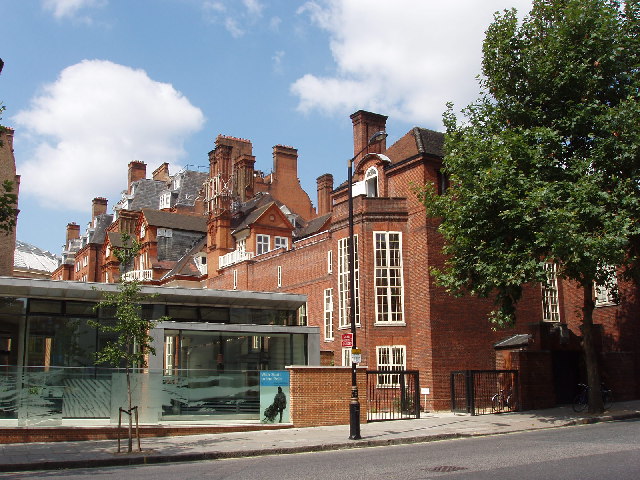
 Figure 1
We have been very fortunate on this course to have had some very good tour guides, and this tour was no exception. Our guide was Mr. Eugene Rae, who is the librarian for the Royal Geographical Society (RGS). The library is located at the headquarters of the society in South Kensington.
The RGS is a private club and currently has approximately 15,000 members. Recent large injections of money from the National Lottery Fund has enabled the building to be expanded, paid for much-needed work to bring all the disparate collections into one area and also subsidized the transferring of the card catalog on to computer records. The main aims of the RGS are to; communicate and exchange information with other Geographical Societies, build and maintain a collection of maps, books and photos, collect scientific instruments, and lastly, provide a forum for the discussion of Geography in general.
The RGS grew out of a gentleman’s dining club, was founded as the RGS in 1830 and originally had premises in Saville Row (where Gieves and Hawkes are now). The RGS moved to its’ present address in 1912, occupying the house that the Speaker of the House of Commons had vacated. Eugene explained that the original building, built in the 1870’s had been added to in the 1920’s and in 2004. After touring the Ondaatje Theater, which is used for lecture programs, we went into what had been the map room.
Eugene explained that the foundation date was significant in terms of the collections that the RGS developed, for by the time the society began, the only areas of the globe that were significantly unexplored, were central Africa and the two poles. Portraits done in oils of Captain Scott, Dr. David Livingstone and Henry Morton Stanley demonstrated his point. The Society provided funding, logistical support, equipment and advice to countless expeditions. The map cases and tables in this room were used to plan many expeditions. There is a real connection with history here, for Scott, Amundsen and Livingstone had all pored over maps in this room whilst planning their expeditions. Appropriately, the only exception to this 19th and 20th Century grouping was a fine portrait of Captain James Cook. Also displayed in this room were models of Mount Everest and a large Portuguese map drawn in the 1640’s, written in Chinese, that was created in great secrecy for the Chinese Emperor.
Before going into the Great Hall, we stopped to look at various exhibits. Henry Morton Stanley, working on instructions from the editor of the New York Herald, went to Africa to look for Dr. Stanley Livingstone. When they met, he greeted him on the shores of Lake Tanganyika with the famous question “Doctor Livingstone, I presume?” Later in the tour, we saw the two hats the two men were wearing in the famous picture produced later, illustrated below:
 Figure 2
Livingstone died in Africa in 1873, and was buried under a tree, his body being interred in Westminster Abbey in 1874. The tree under which he was buried was treated as a temporary head stone. Later, the tree was cut down and the section of the trunk carved with the inscription, was transported to England and it now stands in the RGS building. Illustrated below:
 Figure 3
The library reading room of the RGS is in the most recent 2004 addition to the building. The library contains over two million items comprising;
* Over one million maps and charts
* Over 2,000 atlases
* 500,000 pictures, including many rare photographs
* 250,000 books and periodicals.
The RGS employs 40 staff, of which 9 work in the library and archives.
The Society is home to approximately 1,500 artifacts and Eugene gave us a very thorough and detailed review of some fascinating articles from polar and African expeditions. A stove used in the Peary expedition sat alongside fabric sacks used to apportion “sledge rations” of tea and sugar to the ill-fated Scott polar expedition of 1912. Shackleton’s balaclava-style snow hood, signed by him, is in a remarkably good state of preservation. The Livingsone theme continued, with his signature on his 1857 application to join the Society, signed by all the committee. A simple and elegant picture of the Victoria Falls, drawn by Livingstone is the first picture ever done (by a European) of that cataract.
 Figure 4
Part of that myth was brutally destroyed when in 1999, a TV crew discovered the part-decomposed body of George Mallory on the lower slopes of Everest. Eugene showed us one of Mallory’s boots that was returned from the mountain, and is now being looked after by the RGS. An examination of Mallory’s clothing showed him to have been wearing not much more than a suit jacket and trousers. Andrew Irvine’s body has never been found. I wonder if his descendants are still living in Shangri-La?
For me, this tour has brought to life some fascinating aspects of British polar and African exploration. Our guide, Mr. Eugene Rae, was most kind and generous with the time he gave us, explaining in a very knowledgeable way this most fascinating area of British history.
Royal Geographical Society: www.rgs.org
http://s0.geograph.org.uk/photos/03/50/035092_fc8eba39.jpg
Figure 2: Stanley meets Livingstone
http://www.wayfarersbookshop.com/Biographies/Stanley_Biography/Stanley_-_Dr__Livingstone_I_Pr/Stanley2.jpg
Figure 3: Livingstone's "gravestone"
http://thedkblog.files.wordpress.com/2010/01/livingstone_tree_trunk.jpg



No comments:
Post a Comment